Appalachia Emerges as Ground Zero for U.S. Rare Earth and Critical Mineral Security
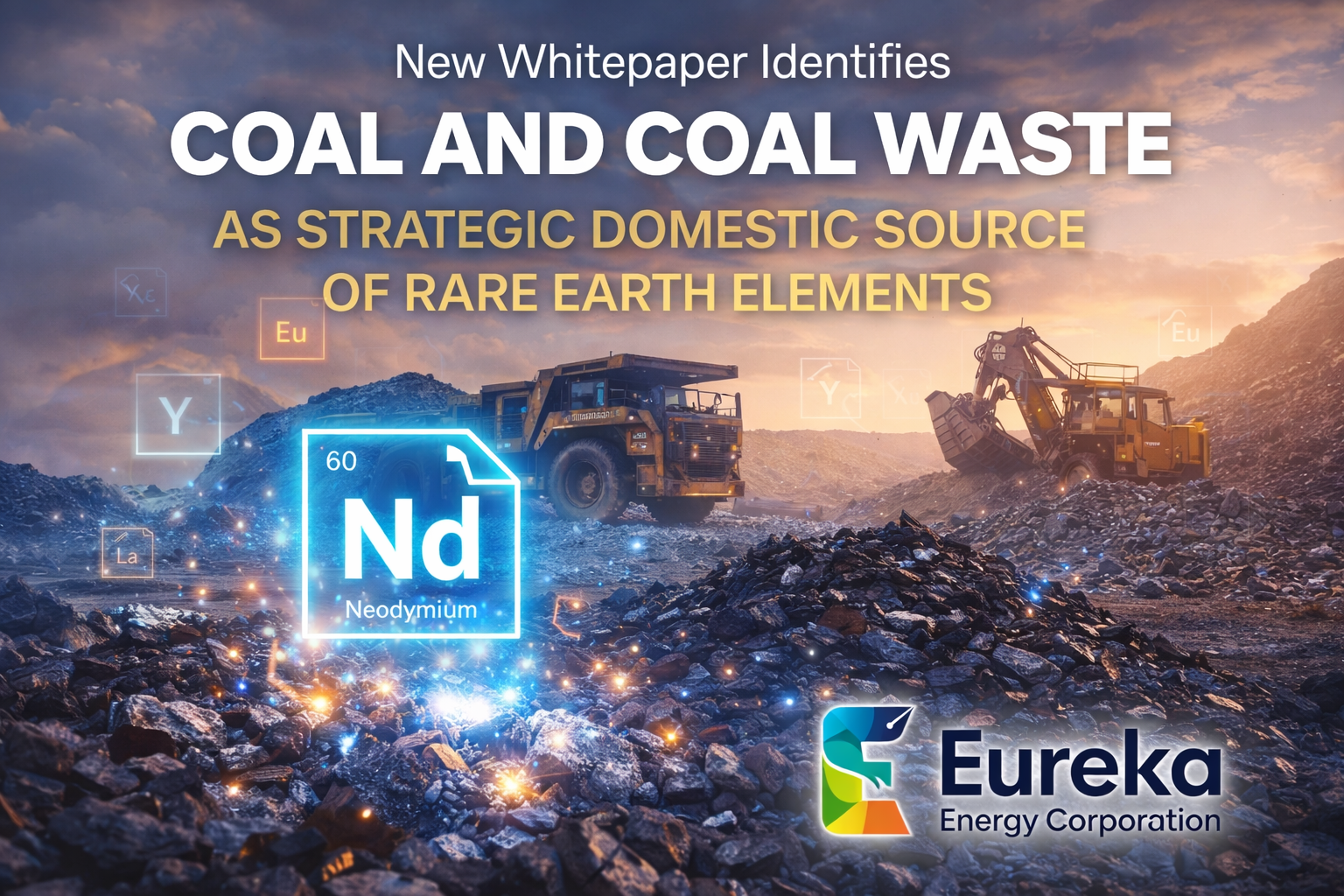
SHERIDAN, WY, UNITED STATES, February 23, 2026 /EINPresswire.com/ — A new national-security–focused whitepaper, Unlocking Strategic Rare Earth Elements from Coal and Coal Waste Streams, presents a commercially grounded pathway for strengthening America’s domestic rare earth element (REE) supply chain using coal-derived materials concentrated in Central Appalachia.
Authored by Roger D. Ford, M.A.; James A. Titmas, P.E.; John Dodson, P.E., M.B.A.; and Kent Sowards, M.B.A., the 54-page analysis synthesizes research from the U.S. Geological Survey (USGS), U.S. Department of Energy (DOE), National Energy Technology Laboratory (NETL), Congressional Research Service (CRS), and Department of Defense (DoD). The report advances a clear conclusion:
Coal and coal waste streams represent one of the most geographically concentrated, surface-accessible, and domestically controlled rare earth resources in the United States.
Strategic Context: China’s Supply-Chain Leverage
The whitepaper documents the structural vulnerability of current global rare earth supply chains. While rare earth minerals are mined in multiple countries, downstream separation, refining, and magnet manufacturing capacity remains heavily concentrated in China.
Key findings cited in the report include:
• China accounts for approximately 65–70% of global rare earth mine production.
• China controls an estimated 85–90% of global rare earth separation and processing capacity.
• Roughly 90% of global NdFeB permanent magnet production remains concentrated in China.
Because rare earth elements are indispensable to defense systems, aerospace platforms, precision-guided munitions, robotics, grid infrastructure, electric motors, and advanced electronics, this concentration represents a direct national security exposure. The report draws parallels to the 1973 oil embargo, arguing that rare earth dependency constitutes a comparable strategic vulnerability requiring proactive industrial policy.
Coal Reframed: From Fuel to Polymetallic Resource
The whitepaper reframes coal not solely as an energy resource, but as a polymetallic material containing measurable concentrations of rare earth elements and other critical minerals.
Coal-derived materials evaluated include:
• Coal combustion products (fly ash, bottom ash, boiler slag)
• Coal refuse and gob piles
• Preparation plant wastes
• Slurry impoundment solids
• Acid mine drainage precipitates
• Flue gases
Federal research demonstrates that certain Central Appalachian coal-derived materials contain rare earth concentrations ranging from several hundred to over 1,000 ppm ΣREE, placing many sites within federally recognized “promising” recovery thresholds.
Critically, these materials are already mined, processed, stored, mapped, and regulated—eliminating the exploration risk, extended permitting timelines, and community opposition typically associated with new hard-rock mining operations.
Gravity Pressure Vessel (GPV) Technology as Commercialization Platform
While DOE and NETL research have validated the scientific feasibility of extracting rare earth elements from coal-derived materials, commercialization barriers remain.
The whitepaper identifies Gravity Pressure Vessel (GPV) technology as enabling industrial infrastructure capable of bridging the gap between laboratory validation and commercial-scale deployment. GPV systems provide:
• Controlled high-pressure, high-temperature environments to enhance extraction kinetics
• Reduced chemical intensity and secondary waste generation
• Modular, feedstock-proximate deployment
• Closed-vessel environmental compliance advantages
• Generation of stabilized post-extraction mineral solids suitable for beneficial reuse
This circular-economy model pairs rare earth recovery with infrastructure-grade mineral co-products suitable for road base, reclamation, structural fill, and industrial site development.
Appalachia as Strategic Launch Platform
The report identifies southern West Virginia and the Central Appalachian corridor as optimal launch regions due to high concentrations of coal-derived feedstocks, multimodal river and rail logistics, existing industrial infrastructure, and a skilled workforce transferable from mining and process industries.
A single commercial-scale GPV facility is projected to support:
• 35–62 direct full-time jobs
• 70–210 total jobs (including indirect and induced impacts)
• Wage bands are significantly above regional manufacturing averages
The authors’ position coal-derived REE recovery not only as a national-security imperative but as an Appalachian economic renewal strategy aligned with workforce redevelopment and brownfield revitalization.
Policy Call to Action
The whitepaper concludes with recommendations to:
• Accelerate demonstration-scale deployment in Central Appalachia
• Align EPA, DOE, and state regulatory frameworks to support materials recovery classification
• Support financing pathways through DOE Loan Programs, DoD Title III authorities, and public–private partnerships
• Integrate coal-derived REE recovery into national critical-minerals strategy
The authors argue that domestic rare earth recovery from coal waste streams represents a strategically viable, politically feasible, and environmentally aligned pathway toward strengthening U.S. industrial sovereignty.
Availability: The full whitepaper, Unlocking Strategic Rare Earth Elements from Coal and Coal Waste Streams, is available for download.
Roger D Ford
Eureka Energy Corporation
+1 307-352-2498
roger@eureka-energy.com
Visit us on social media:
LinkedIn
Facebook
X
Legal Disclaimer:
EIN Presswire provides this news content “as is” without warranty of any kind. We do not accept any responsibility or liability
for the accuracy, content, images, videos, licenses, completeness, legality, or reliability of the information contained in this
article. If you have any complaints or copyright issues related to this article, kindly contact the author above.